Compliance
The CMS 2027 Final Rule: What Medicare Agents Need to Know Before AEP

On April 2, 2026, CMS released the Contract Year 2027 Final Rule. It's one of the most agent-friendly rule updates in years — and it directly affects how you'll sell during AEP starting October 15.
Here's what actually changed, what it means for your day-to-day, and how to stay compliant.
1. The 48-hour SOA waiting period is gone
This is the big one.
Previously, you had to wait 48 hours after a beneficiary signed a Scope of Appointment before you could have a plan-specific conversation. That rule created a frustrating gap: clients who were ready to talk had to wait, and agents lost warm leads to a cooling-off period that often just meant confusion and second-guessing.
What changed: CMS eliminated the 48-hour waiting period entirely. Once a beneficiary signs an SOA, you can move directly into a plan discussion — same day, same meeting, same phone call.
What didn't change: You still need a signed SOA before discussing specific plans. The form itself isn't going away. CMS just removed the arbitrary time gap.
What this means for you: Faster conversions, fewer lost leads, and a more natural sales flow. When someone sits down with you and says "I want to talk about my options," you no longer have to say "great, let's schedule something for Thursday."
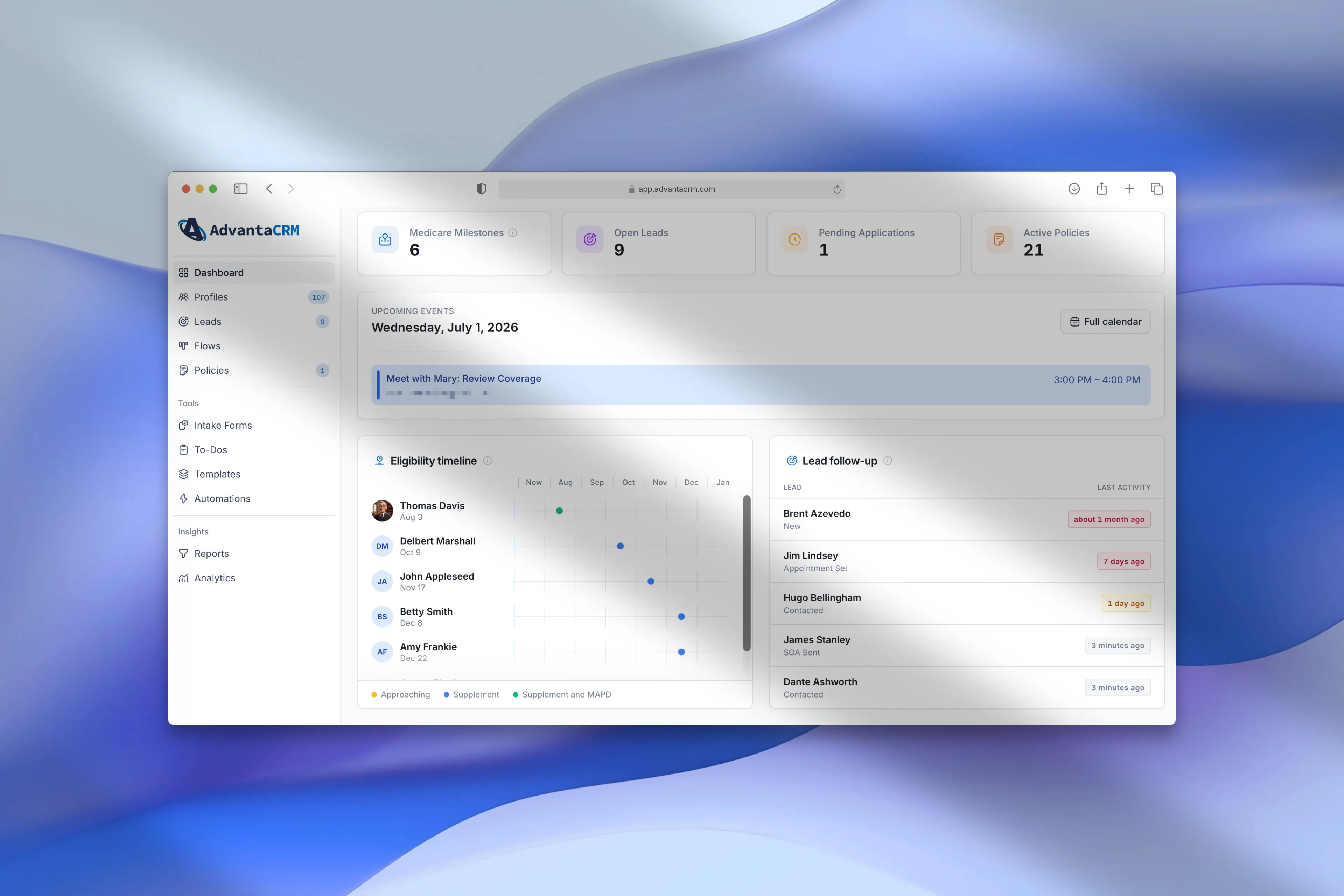
How AdvantaCRM helps: AdvantaCRM's built-in SOA tracking lets you send, collect, and store SOAs digitally — with timestamps, audit trails, and automatic reminders. Now that same-day appointments are allowed, having instant SOA capture matters more than ever. Your SOA is signed, timestamped, and stored before the conversation even starts.
2. SOAs can be collected at educational events
Previously, distributing or collecting SOA forms at educational events was prohibited. You could teach, but you couldn't set up the next conversation.
What changed: You can now collect signed SOAs at educational events. The educational portion still has to remain purely educational — no plan comparisons, no sales pitches — but attendees who want a follow-up appointment can sign an SOA on the spot.
What this means for you: Educational events just became a real lead generation channel. Host a Medicare 101 seminar, answer questions, and at the end, anyone who wants to take the next step can sign an SOA right there. No chasing them for paperwork three days later.
How AdvantaCRM helps: With digital SOA collection built into AdvantaCRM, you can capture signatures at events from a tablet or phone. Every SOA is automatically linked to the client record, timestamped, and stored for compliance. No paper forms to scan later. No wondering if you have a valid SOA on file.
3. The 12-hour educational-to-marketing event gap is eliminated
CMS used to require a 12-hour buffer between an educational event and a marketing event at the same location. The idea was to prevent pressure — but in practice, it just meant two separate events on two separate days.
What changed: You can now hold a marketing event immediately after an educational event at the same location. Attendees must be clearly told the session is transitioning from education to marketing, and they must be given the opportunity to leave.
What this means for you: One evening, two events. Run your Medicare 101 session, take a short break, announce the transition, and move into a plan-specific presentation for anyone who stays. This doubles the value of every event you host.
4. TPMO disclaimer timing is more flexible
The old rule required you to deliver the full Third-Party Marketing Organization (TPMO) disclaimer within the first 60 seconds of a call or meeting. That made for some awkward openers.
What changed: The disclaimer now just needs to be delivered before you discuss specific plan benefits. There's no 60-second clock. You can open a conversation naturally — verify who you're speaking with, understand their situation, build rapport — and then deliver the disclaimer before diving into plan specifics.
What this means for you: More natural client conversations. You can be a human first and a compliance checkbox second. The disclaimer still has to happen — it just doesn't have to be the first words out of your mouth.
5. Superlatives are now allowed in marketing materials
CMS has loosened restrictions on language in marketing materials. Terms like "best," "most," and "top-rated" are now permitted — as long as the claims are accurate and not misleading.
What this means for you: Your marketing materials can be more direct and persuasive. But don't get sloppy — CMS still prohibits misleading advertising. "Best Medicare agent in [city]" without supporting evidence is still risky. "I've helped 200 seniors in [county] find coverage" is specific, accurate, and now clearly within bounds.
6. Call recording retention is reduced from 10 years to 6 years
CMS shortened the required retention period for sales and marketing call recordings from 10 years to 6 years. The agency determined that the longer period was overly burdensome and provided little enforcement value.
What changed: You still must record all calls that involve plan discussions — even if the client doesn't enroll. But you're now required to retain those recordings for 6 years instead of 10.
What this means for you: Lower long-term storage costs and a simpler compliance process. But don't delete anything retroactively without checking with your compliance team or upline first.
How AdvantaCRM helps: AdvantaCRM includes built-in call recording storage mapped to client records. Every recording is automatically linked to the right contact, timestamped, and stored for the required retention period. No third-party integration, no manual file management, no wondering where that recording from 2024 went.
Key dates to remember
April 2, 2026 — CMS published the CY 2027 Final Rule
June 1, 2026 — Rule becomes effective
October 1, 2026 — Updated marketing rules apply; AEP marketing for 2027 plan year begins
October 15 – December 7, 2026 — Annual Enrollment Period (AEP)
January 1, 2027 — 2027 plan year begins
What to do right now
Update your event strategy. Plan educational events that flow into marketing events. Have digital SOA capture ready to go.
Update your call scripts. Move the TPMO disclaimer to a natural break point before plan-specific discussion, not the first 60 seconds.
Review your marketing materials. You have more language flexibility now — use it wisely and accurately.
Check your call recording setup. Make sure every plan discussion is being recorded and stored in a system that's linked to the client record. Update your retention policy to reflect the 6-year requirement.
Prepare for a faster AEP. With same-day SOA appointments now allowed, your speed-to-lead matters more than ever. Make sure your CRM can keep up.